Rapid axially scanned and de-scanned line-scan confocal microscopy with a tunable acoustic gradient index of refraction lens for high-speed volumetric in vivo imaging
- Type
- Article
- Citation
- NEUROPHOTONICS, v.12, no.4
- Issued Date
- 2025-10
- Abstract
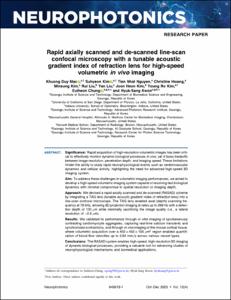
- Significance: Rapid acquisition of high-resolution volumetric images has been critical to effectively monitor dynamic biological processes in vivo, yet it faces tradeoffs between image resolution, penetration depth, and imaging speed. These limitations hinder the ability to study rapid neurophysiological events such as cerebrovascular dynamics and cellular activity, highlighting the need for advanced high-speed 3D imaging system. Aim: To address these challenges in volumetric imaging performances, we aimed to develop a high-speed volumetric imaging system capable of resolving fast biological dynamics with minimal compromise in spatial resolution or imaging depth. Approach: We devised a rapid axially scanned and de-scanned (RASAD) scheme by integrating a TAG lens (tunable acoustic gradient index of refraction lens) into a line-scan confocal microscope. The TAG lens enabled axial (depth) scanning frequency at 70 kHz, allowing 3D projection imaging at rates up to 200 Hz with a detection depth of 135 mu m while minimally sacrificing the image quality (i.e., a lateral resolution of similar to 2.6 mu m). Results: We validated its performance through in vitro imaging of spontaneously contracting cardiomyocyte aggregates, capturing real-time calcium transients and synchronized contractions, and through in vivo imaging of the mouse cortical tissue, where volumetric acquisition over a 450x450x100 mu m(3) region enabled quantification of blood flow velocities up to 3.64 mm/s across various vessel types. Conclusions: The RASAD system enables high-speed, high-resolution 3D imaging of dynamic biological processes, providing a valuable tool for advancing studies of neurophysiological mechanisms and biomedical applications.
- Publisher
- SPIE-SOC PHOTO-OPTICAL INSTRUMENTATION ENGINEERS
- ISSN
- 2329-4248
- Appears in Collections:
- Department of Biomedical Science and Engineering > 1. Journal Articles
Research Institutes > 1. Journal Articles
- 파일 목록
-
-
Download
 f842398b_c842_4614_a2a7_02736b42e002.pdf
기타 데이터 / 4.01 MB / Adobe PDF
f842398b_c842_4614_a2a7_02736b42e002.pdf
기타 데이터 / 4.01 MB / Adobe PDF
-
Items in Repository are protected by copyright, with all rights reserved, unless otherwise indicated.