GIST Scholar
College of Engineering
Department of Materials Science and Engineering
1. Journal Articles
Construction of Hierarchical Surface on Carbon Fiber Paper for Lithium Metal Batteries with Superior Stability
- Type
- Article
- Citation
- Advanced Energy Materials, v.13, no.9
- Issued Date
- 2023-03
- Abstract
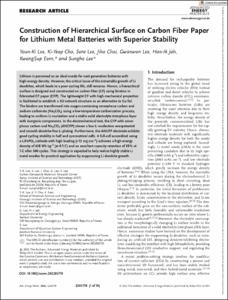
- Lithium is perceived as an ideal anode for next generation batteries with high-energy density. However, the critical issue of the intractable growth of Li dendrites, which leads to a poor cycling life, still remains. Herein, a hierarchical surface is designed and constructed on carbon fiber (CF) using binders in fabricated CF paper (CFP). The lightweight CF with high mechanical properties is facilitated to establish a 3D network structure as an alternative to Cu foil. The binders are transformed into oxygen-containing amorphous carbon and sodium carbonate (Na2CO3) using a low-temperature carbonization process, leading to uniform Li nucleation and a stable solid electrolyte interphase layer with inorganic components. In the electrochemical test, the CFP with amorphous carbon and Na2CO3 (ANCFP) shows a low Li nucleation overpotential and smooth dendrite-free Li plating. Furthermore, the ANCFP electrode exhibits good cycling stability in half and symmetrical cells. A full-cell assembled using a LiFePO4 cathode with high loading (≈13 mg cm−2) achieves a high-energy density of 428 Wh kg−1 (at 0.1 C) and an excellent capacity retention of 85% at 1 C after 300 cycles. This strategy is expected to help realize highly stable Li metal anodes for practical application by suppressing Li dendrite growth.
- Publisher
- Wiley-VCH Verlag
- ISSN
- 1614-6832
- Appears in Collections:
- Department of Materials Science and Engineering > 1. Journal Articles
- Files in This Item:
-
-
Download
 Advanced Energy Materials _ 2023 _ Lee _ Construction of Hierarchical Surface on Carbon Fiber Paper.pdf
기타 데이터 / 1.76 MB / Adobe PDF
-
Items in Repository are protected by copyright, with all rights reserved, unless otherwise indicated.